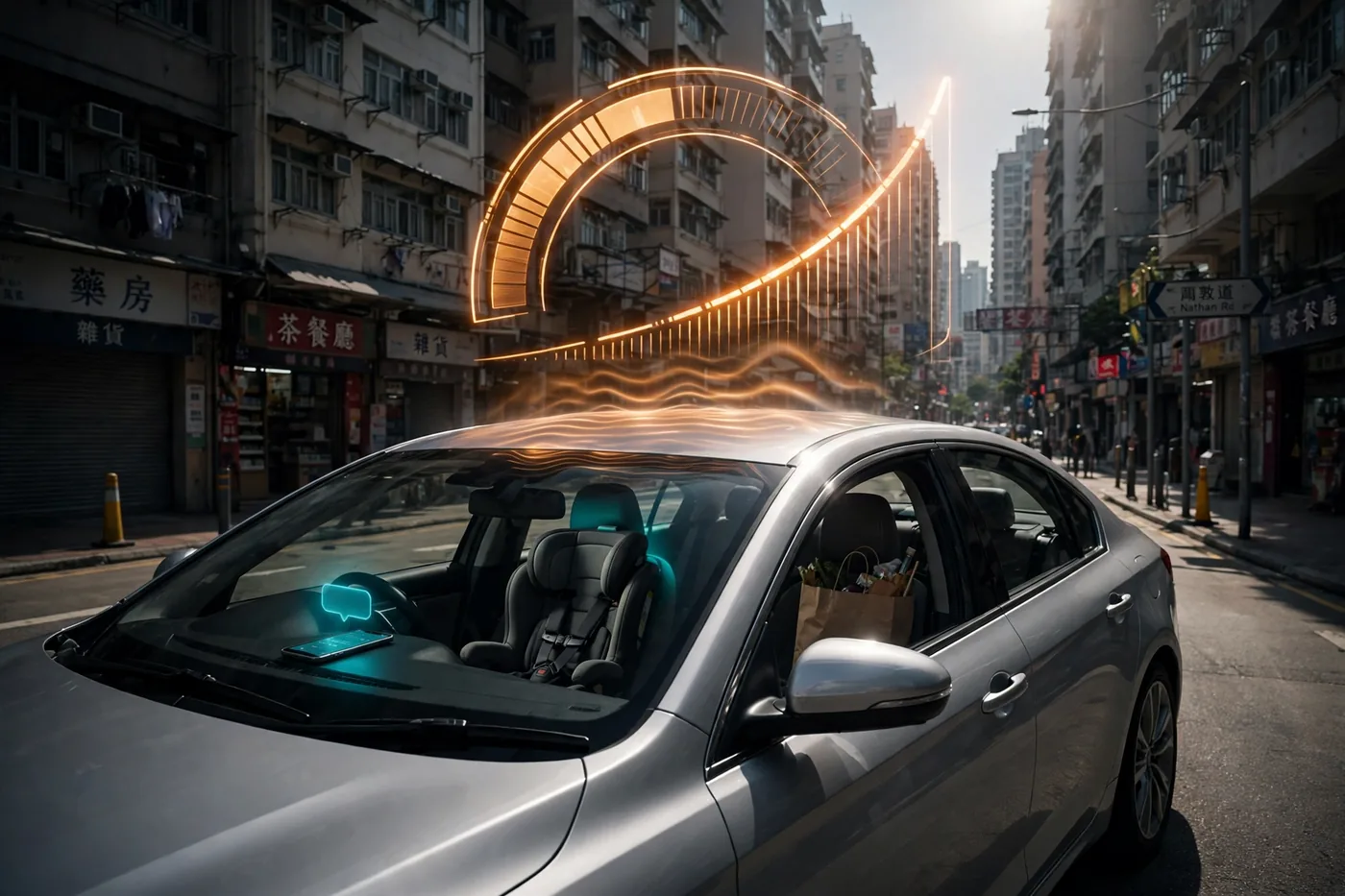
No new head unit. No dealer app. No carmaker subscription. The module plugs in, brings its own SIM, and Muse talks to it over 4G — not through your phone.
Data-only. No voice calls, including WhatsApp calls. The link is the module's, not the vehicle's or anyone's phone.
Live satellite fix outdoors, cell-tower estimate indoors. Logged about once a minute, roughly 88 days of history on the card.
A still photo on demand over 4G, wherever it is parked. Video recording is not implemented and is listed as roadmap.
Listens to the vehicle's own Bluetooth hardware — tyre-pressure sensors and an OBD2 diagnostic dongle.
Real phrasing that works today, typed into Muse on a phone.
Two things are true at once, and it matters which one you read. The connection is verified on a real vehicle. The readout inside Muse is still being finished.
The module found the ELM327 dongle (advertised as V011), connected to it, and read the vehicle's VIN.
obd.read answers on the gadget itself, read-only: RPM, speed, coolant (intermittent), engine load, throttle, fuel, 12 V, fault-code count, plus a 15-minute rolling historyA standard dongle provides
Honest limit: OBD2 is a standard emissions and diagnostics port. It does not expose brand-specific body systems — lights left on, door or lock state, windows — on most vehicles. Coverage varies by vehicle, and the gadget says so when a value is not supported.
All four wheel sensors on the test vehicle broadcast as DJTPMS. The module hears all four — repeatedly, parked and through a 97 km/h drive.
A decoded advertisement typically gives, per wheel
Even before decoding ships, presence monitoring is useful: the module confirms all four are alive and reporting, and notices when one stops — itself a fault worth a line in the weekly report.
Both are decoded on the module itself. No cloud round trip, no vendor app, no subscription. The lists below are what firmware 0.1.124 actually returns, confirmed on a Mercedes-Benz E300L.
Plugs into the diagnostic socket, pairs over Bluetooth LE, and the module polls it about once a second.
| Reading | OBD-II PID | On the test E300L |
|---|---|---|
| Engine RPM | 01 0C | 798 rpm |
| Vehicle speed | 01 0D | 0 km/h (stationary) |
| Coolant temperature (intermittent on the current unit) | 01 05 | 75 °C |
| Engine load | 01 04 | 22.7 % |
| Throttle position | 01 11 | 13.7 % |
| Fuel level | 01 2F | 76.9 % |
| Control-module voltage | 01 42 | 14.2 V |
| Fault-code count | 01 01 / 03 | 0 |
| VIN | 09 02 | LE4ZG4JB3KL301853 |
| Any other mode-01 PID | on request | raw value + unit |
No pairing, no connection. The module listens to the BLE advertisements the sensors already broadcast and decodes them on-device, verified by CRC8. The sensors rotate their Bluetooth address, so each sensor is identified by its payload, not by its MAC. What is not done yet: assigning each sensor to a wheel position (front-left and so on) — that mapping is planned.
| Reading | Unit |
|---|---|
| Per-sensor absolute pressure | kPa |
| Gauge pressure | kPa |
| Pressure, in your units | bar / psi |
| Tyre temperature | °C |
| Sensor identity | hex id |
| Signal strength | dBm |
| Age of last reading | ms |
| Rolling history | 15 min / 60 samples |
What it will not do: clear fault codes, actuate anything, or write to the vehicle. Both readers are strictly read-only by design. Odometer is not a standard OBD-II value — most cars need a manufacturer-specific PID, so treat mileage as best-effort. Readings live in a 15-minute ring buffer on the module; they are not uploaded to any server.
Not a render. On 4 November 2026 the module read a live Mercedes-Benz E300L and produced the weekly inspection report itself. These are the numbers it returned, and the three things it could not answer — printed in red on the report, in the product, rather than buried in a roadmap.
The only note the report raised: fuel at 34 %. No action required that week.
20 Nov 2026 — parked, and still answering. The test vehicle sat unattended from 7 November with the engine and ignition off. Over 4G it still answered: it sent a camera frame and built a report from its own records — tyre pressures, the GPS track, and an engine snapshot from before shutdown. No one walked out to the vehicle and no laptop was plugged in. The frame is real and shown rotated, because the camera is mounted upside down on this unit; the colour cast is still being tuned. 25-second clip · Instagram · Facebook
Ten public build posts for the Muse Gadget. Each row is one clip, linked wherever it was posted. The captions on the posts are the source of truth for what was claimed at the time.
Every AI gadget hits the same wall. It can listen and answer, but the earbuds in between belong to a phone — Bluetooth earbuds pair with the handset they were set up on, so the phone stays in the middle of the audio path.
So we built earphones that connect straight to the gadget, with no phone in between. The ear clip is the first model, launching mid-December 2026. Any gadget that implements the connection SDK can pair, and that SDK is open source on ESP32. OWS AI earphones, by Skytech — designed in Hong Kong, made in Thailand.
The ear clip ships mid-December 2026. It is not on sale yet. Evaluation samples are available on request: info@skytech.com.hk.
Most vehicle gadgets hand you a dashboard and let you work out what it means. This one hands you a paragraph, once a week, that tells you whether anything needs doing.
Report produced by Muse today. Automated weekly scheduling is roadmap; on-demand inspection works now.
Three columns, no ambiguity. If it moves up, it is because it was tested — not because a deadline arrived.
Deliberately not claimed: video recording; vehicle 12 V readings on the current test unit (sensor not fitted); OBD2 actuation or code clearing (read-only by design); and a finished consumer dashboard. Tyre positions are not assigned yet, so a reading is not yet tied to a named wheel. When any of them ships, it moves up a column — and the date it was verified goes with it.
| Uplink | 4G LTE, own SIM, data-only — SIM7670X |
| Position | GNSS via SIM7670X, cell-tower fallback indoors |
| Camera | OV5640 — VGA stills on demand over 4G |
| Hotspot | Wi-Fi 6, bridged from 4G |
| Bluetooth | BLE pairing for TPMS / OBD2 / remote-start peripherals |
| Storage | Local track log, roughly 88 days |
| Voice calls | Not supported — 4G is data-only |
Designed in Hong Kong · Manufactured and tested in Thailand
Real hardware — Module 1 on the bench, powered up. Not a render.
The firmware is finished. After months of road testing every feature is live on firmware 0.1.124 — and the inspection report is written by the gadget itself: GPS tracking, engine diagnostics, tyre pressure, camera. All passing, all real.
That leaves the one thing we would rather not decide alone — the enclosure. Four shapes, four kinds of installation. The highest-rated shape is the one we build.
The classic box. Hardwired, hidden under the dash, camera on the front.
Fits: Cars, vans and anything with a dash to hide it behind.
On the windscreen, dashcam style, watching the road ahead.
Fits: Owner-drivers who want the forward view as well as the data.
Built for construction. Bolted down, bumpers on the corners, a guard over the lens.
Fits: Site machines that get hit, dragged and left in the rain.
Flat and magnetic. Sticks onto containers, trailers, anything steel.
Fits: Assets with no dash, no cab and no bracket.
These are concept descriptions of the four enclosure options, not photographs of production hardware — nothing is moulded yet. The choice is being made in public: vote A, B, C or D in the comments of the build video. A working concept, in final testing. Not on sale.
Most gadgets ask for your accounts. This one is built so it cannot take them.
In your own Muse account. Not ours.
Straight into the gadget during setup. Nothing sits in between.
No Skytech database holds it — there is no step where it would arrive.
We never see it. We never store it. That is not a policy we wrote — it is the shape of the design. The path does not exist.
No installer, no engineer visit. The box arrives, you plug it in, and the setup page does the rest — register the gadget, write your own token, pair it, give it a name. Open box, plug in: that is the hard part done.
Setup takes minutes: plug it in, open the page, follow the steps. The only thing you hand over is the gadget itself.
Published on YouTube 8 and 9 Nov 2026 and Instagram 8 Nov and 9 Nov 2026. A working concept, in final testing. Not on sale.
Illustrative concept visuals — not product photography. Replaced with real captures as units come off the bench.
The module is in life test, not on a shelf. If you want to run a pilot on your own fleet or vehicle, or you manufacture aftermarket car electronics and want to talk, write to us.
The wider idea
The constraint we were designing around turned out to be “things with a screen”, not “vehicles”. The same box belongs on anything that moves.